


AI is everywhere today. New tools, agents, automations and promises of faster development or lower costs are appearing all the time. For companies, it is becoming increasingly important to understand what has real value, where to start and which solution will actually fit their processes, data and goals.
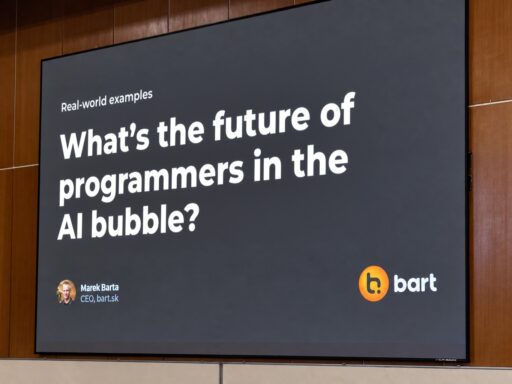
This is exactly what we focused on during our online meetup about using AI in digital product development. We selected 5 key ideas from the session to help you navigate the topic faster and show why the full recording is worth watching.
1. AI can get you to the result faster — even the wrong one
With AI, a good brief matters more than ever. Without it, you can get not only to a better solution faster, but also to an expensive mistake.
That is why it is important to clearly define what the solution should change in practice and what data it can work with.
This is why we created chat.bart.sk — an AI chatbot with the context of a specific project, which helps our clients prepare better input for the development team through follow-up questions. The customer does not need to arrive with a finished specification. It is enough to bring a need or an initial idea, and chat.bart.sk helps turn it into a brief the team can start working with faster and more precisely.
2. AI brings more value when it works with company data
There is a major difference between an AI tool with general knowledge and an assistant connected to a specific company environment. A standard AI tool works with what it already knows, or with what you manually paste into the chat, and usually gives you average results.
For company solutions, it is far more useful to work with up-to-date data from orders, warehouse systems, CRM or accounting software.
Systems like MCP servers can securely connect these tools to an AI assistant. Thanks to them, you can ask your preferred chat about the best-selling product, pending invoices, order status or dispatch times, and receive an answer, table or chart without manually searching through multiple tools. Data can then become a basis for decisions, tasks or concrete process improvements much faster.
The next level is connecting the chat directly to the administration environment. The user enters the requested change into a chat window, and the AI agent can execute it in the system. We are already applying solutions like this in our clients’ projects.
3. Internal tools finally make economic sense thanks to AI
A chatbot in administration is just one example of a smaller solution that can simplify repetitive or time-consuming tasks inside a company. Automations, dashboards, process visualisations or custom internal applications can work in a similar way.
What looked like a luxury a few years ago often makes economic sense today thanks to AI.
All you need is a clearly defined problem, and the first usable version of a tool can be ready within dozens of hours. One example is the booking application for Dr.Max, which our team built in 3 weeks and which is now already used in practice.
4. An older system is no longer a barrier to further development
In the past, companies often had to adapt to technology. Today, that balance is changing. AI can also help with systems that were built over many years, remain important for the business, but whose further development is slowed down by weaker documentation, older code or missing support from the original supplier.
Our colleagues recently took over a large solution consisting of a website, API, database, mobile application and integrations with external services. The biggest challenge was to quickly understand how the system works and where to look when handling new customer requirements.
This is where AI helped significantly. It shortened the time needed to understand the code, add documentation, prepare tests and find connections within the system.
Thanks to this, we can take over even complex existing solutions faster, understand their logic and continue developing them safely.
5. High-volume content can now be generated at a usable quality
Another major area where AI brings practical value is content. This is especially true in e-commerce, where content directly affects visibility, customer orientation and sales.
At the meetup, we showed how AI can speed up category planning, product descriptions, metadata and translations.
We also presented product image generation — from banners highlighting product benefits to visuals with a consistent mascot and product placement.
In the examples shown, the cost of generating images via API was under 10 cents per image, depending on the complexity of the brief. With a well-set process, generating thousands of similar images in a short time is entirely realistic.
You can find more concrete examples, technical context and real-life use cases in the recording of our online meetup. The recording is in Slovak, so English-speaking viewers can use YouTube’s auto-translate captions if they are available for the video.
If you already have a process, idea or system you want to move forward, we will be happy to help you identify the opportunity and design a solution that makes sense for your team, data and customers.
Frequently Asked Questions
When does an AI solution bring real value to a company?
AI brings real value when it addresses a specific business need. It can help speed up processes, make data more accessible, reduce manual work, support sales, improve customer experience or further develop existing digital solutions.
Where should a company start with AI?
The best starting point is a specific situation you want to improve. This may be a process slowing down your team, repetitive manual work, hard-to-access data, a postponed feature or content you prepare at scale.
Why is a good brief important when working with AI?
AI can significantly speed up the path to a result, which is why it is important to set the right direction. A good brief helps define the goal, expectations, data, boundaries and what the solution should change in practice.
What is chat.bart.sk?
chat.bart.sk is an AI chatbot with the context of a specific project. Through follow-up questions, it helps clients turn an initial idea or need into a better brief that the development team can work with faster and more precisely.
What is an MCP server?
An MCP server enables a secure connection between an AI assistant and a company’s internal systems. Thanks to this, AI can work with data from orders, warehouse systems, CRM or accounting software.
How can AI work with company data?
When an AI assistant is connected to the right systems, users can ask it in a chat about the best-selling product, pending invoices, order status or dispatch times. The result can be an answer, table or chart without manually searching through multiple tools.
Which company processes are worth automating with AI?
AI is worth considering for tasks that repeat often, take up the team’s time or require work across several systems. Typical examples include reports, spreadsheets, order checks, data processing, internal requests or information search.
When does it make sense to create a custom internal tool?
A custom internal tool makes sense when a company regularly deals with a process that slows it down or requires a lot of manual work. Thanks to AI, the design, development and testing of such a solution can be more accessible than in the past.
Can AI help with an older system or existing code?
Yes. AI can help developers understand existing code faster, add documentation, prepare tests and find connections in systems that were built over many years or have weaker support. This gives the company a stronger foundation for further developing an important solution.
How can AI help an online store with content?
In e-commerce, AI can help with category planning, product descriptions, metadata, translations or product visuals. For large product catalogues, it helps process content faster, more consistently and at a more reasonable cost.
Can AI generate large volumes of product images?
Yes, with a well-set process, AI can be used to generate large volumes of product images, banners or visuals in a consistent style. In the examples from the meetup, the cost of image generation via API was under 10 cents per image, depending on the complexity of the brief.
Does AI replace developers or internal teams?
AI does not replace team responsibility. It helps speed up analysis, preparation, development, testing or work with data, but decisions, quality control and technical direction remain in human hands.
Where can I see concrete examples of AI use in companies?
You can see concrete examples of AI use in briefs, data work, internal tools, older systems and e-commerce content in the recording of the bart.sk online meetup about using AI in digital product development. The recording is in Slovak, so English-speaking viewers can use YouTube’s auto-translate captions if they are available for the video.