

Is learning to code still worth it? Will AI replace junior developers? And what happens if the AI bubble bursts? Computer science students asked our CEO Marek Barta more than 40 questions about the future of software development. Here are his answers – and they matter far beyond the lecture hall.
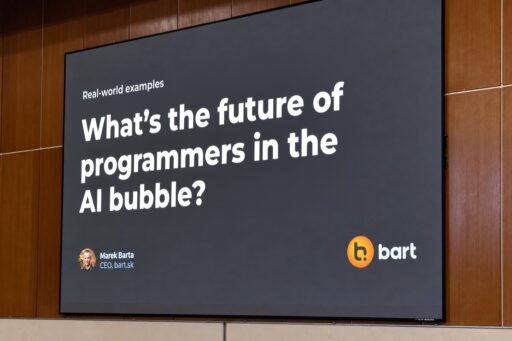
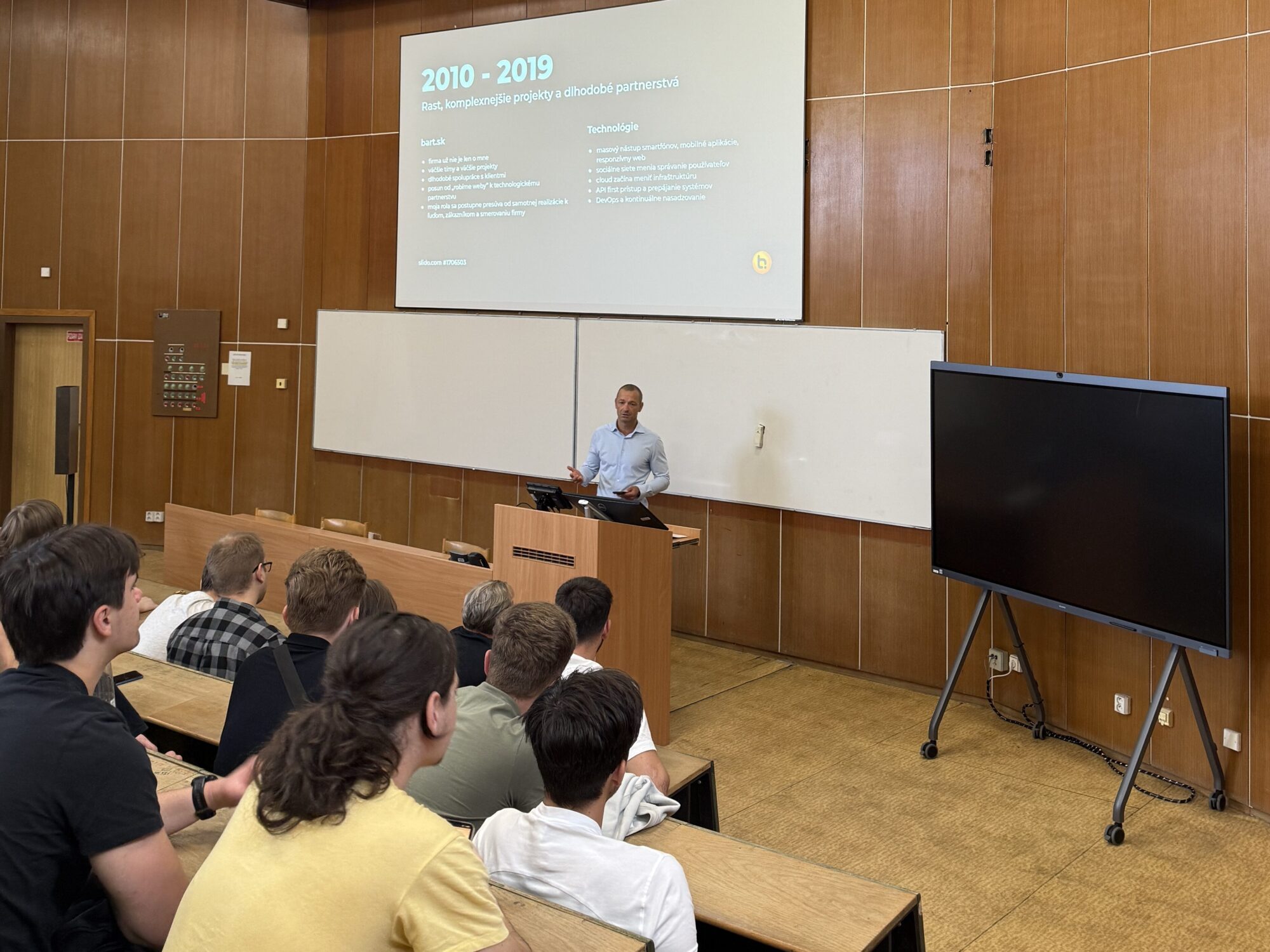
Every year, we visit the Technical University of Košice (TUKE) in Slovakia to share real-world experience with computer science and cybersecurity students. This time, Marek’s talk tackled one big question: What’s the future of programmers in the AI bubble? The session was planned for 90 minutes. It ran for over two hours. 48 out of 150 students chose to stay long after it officially ended – just to keep the conversation going.
The questions they raised are the same ones developers, tech leads and business owners are asking right now. So we didn’t want to leave the answers in the lecture hall. Here are the highlights.
How do you break into IT when the market is saturated and companies are cutting jobs?
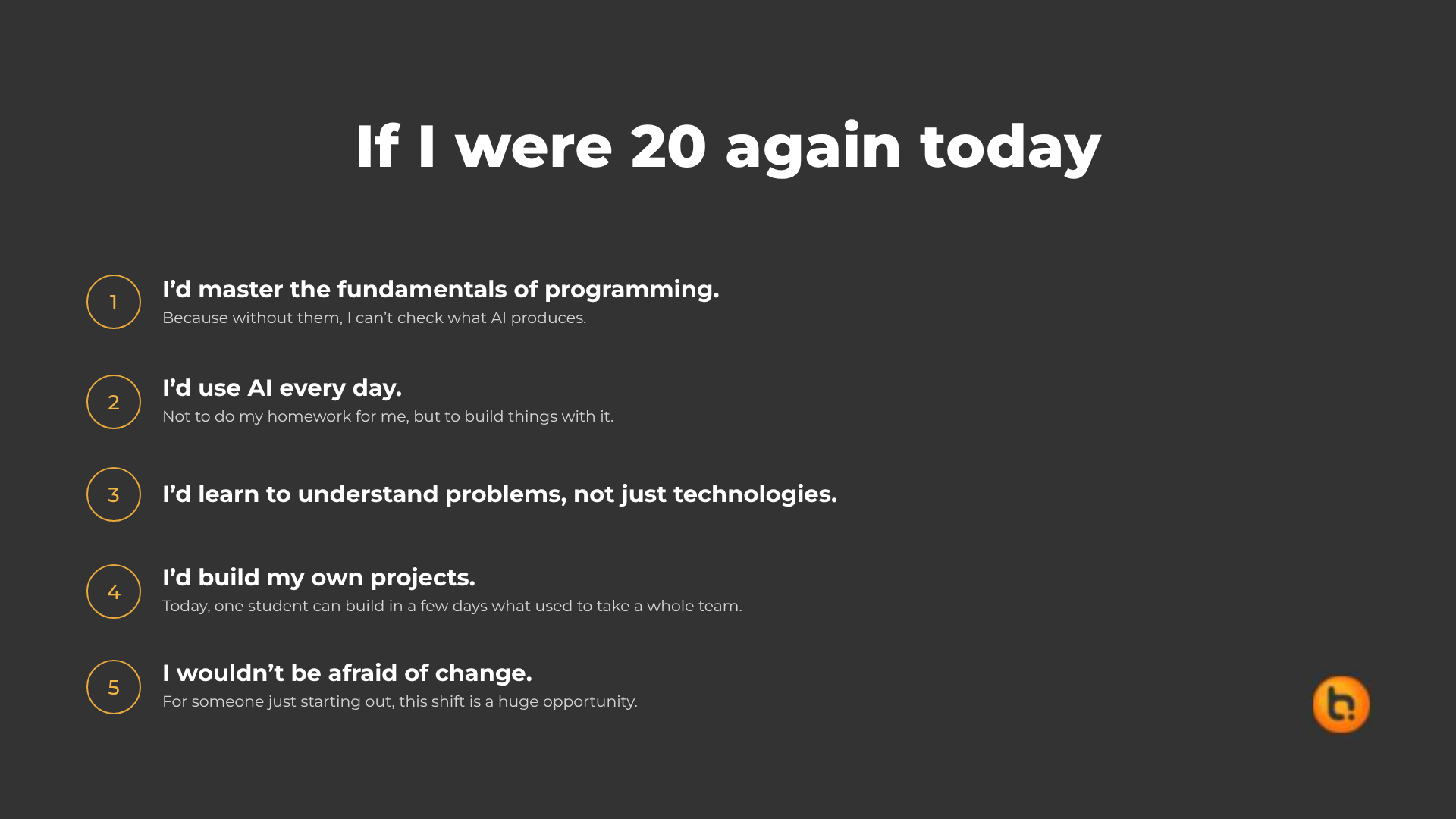
Start building experience before you graduate. With AI, a single student can now build in a few days what once took an entire team. So build something of your own that solves a real problem. Put it in front of real users, listen to their feedback and keep improving it.
A project built with AI can still be a strong showcase of your skills. What matters is that you understand it, can explain your decisions and can show what problems you solved along the way.
Student teams, open-source projects and hackathons are just as valuable. They teach you to work with someone else’s code and to solve problems together with other developers – exactly what you’ll do on day one of a real job.
When you apply for your first job, you’ll have something real to show. List your projects on your CV, link to a live demo or repository and briefly describe what you built and what you contributed.
Will we still write code by hand, or will 99% of the job be vibe coding?
Both. For some tasks, writing the code yourself will be faster. For others, AI will handle most of the implementation. Either way, a developer still has to understand the existing system, define the task precisely and verify the result.
Because code that works isn’t necessarily the right solution. An app can pass a simple test and still break during integration or under real user load. That’s why solid programming fundamentals matter more than ever.
Use AI as a learning tool, too. Ask it to explain unfamiliar code, experiment with your own changes and compare different approaches. But keep practicing coding on your own – so you can judge the output even without AI’s help.
What makes a developer truly valuable in the age of AI?
A good developer knows whether they’re solving the right problem. A client may ask for a brand-new feature when a simple tweak to the existing system would meet their need. Spotting that difference is often worth more than the implementation itself.
That’s why Marek encouraged students to focus on 3 core skills:
- Defining problems and designing solutions. Asking the right questions, understanding the real need and proposing the right approach.
- System design and architecture. Understanding how the parts of a system work together and what consequences technical decisions have.
- Business thinking and communication. Explaining a technical solution to people outside IT and understanding the value it brings to the client.
Practice these skills on every project. Challenge your first idea and look for a better one. Test what happens when the number of users grows or the requirements change. And try defending your decisions to someone who doesn’t code.
Isn’t AI just a bubble, when the companies building LLMs are losing money?
It’s possible that today’s expectations of AI are inflated. Companies are pouring enormous sums into building models, and it’s still unclear whether those investments will pay off.
But even if some AI companies fail, AI won’t simply disappear from software development. It already helps with coding, testing and data analysis – and those use cases deliver real, practical value.
So instead of betting everything on a single tool, learn how to use AI effectively in real work.
3 key takeaways worth putting into practice
- Understanding code matters more than generating it.
- The best way to learn AI is to build something with it.
- A developer’s value starts with asking what actually needs to be solved.
And if Marek were 20 again today, he’d follow the same advice he closed his talk with:
“I wouldn’t be afraid of change. For someone just starting out, this shift is a huge opportunity.”
A big thank you to the Technical University of Košice for welcoming us every year. Conversations with students keep us sharp – their questions and perspectives are just as valuable to us as our experience is to them.
FAQ: Software development careers in the age of AI
Is it still worth learning to code now that AI can write code?
Yes. Programming fundamentals are essential even when working with AI. Developers need to understand the code, spot bugs, evaluate proposed solutions and verify that they work within the whole system. AI can speed up implementation, but the developer remains responsible for getting the result right.
Will AI replace junior developers?
AI is changing what junior developers do, not making them unnecessary. Routine coding tasks are increasingly automated, so juniors who stand out are those who understand fundamentals, can review and verify AI-generated code and know how to turn a vague requirement into a clear task.
How can I get into software development without work experience?
Build your own projects while you’re still studying. Create a working app, have real people test it and keep improving it. Join student teams, contribute to open source or take part in hackathons. When applying for your first job, you can show a concrete result, link to your repository and explain your technical decisions.
What skills will developers need in the age of AI?
Beyond coding itself, the ability to understand and define a problem, design the right solution and verify the result is becoming increasingly important. In his talk, Marek Barta highlighted three areas: problem definition and solution design, system design and architecture, and business thinking and communication.
What if AI is a bubble and some AI companies fail?
Massive investment in AI doesn’t guarantee that every company will succeed. But the failure of some players doesn’t mean the end of AI in software development. That’s why it pays to build strong fundamentals, problem-solving skills and hands-on AI experience that carries over across different tools.