


Can a technology partner genuinely speed up your business, or will they simply become an expensive executor of tasks? Where is the line between efficiency and wasted effort? And when is AI a real helper — and when is it a risk that can introduce errors into your system?
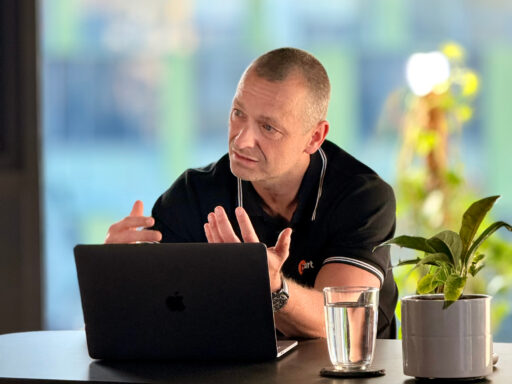
These are the kinds of questions every business leader is likely to ask when looking for a strategic IT partner. During their visit to bart.sk, two representatives of our long-term client Dr.Max shared their perspective: Rostislav Stepina, Release Manager at MageXo, a supplier company for Dr.Max, and Petr Vondráček, Business Analysis at Dr.Max. They deal with these challenges every day on an international scale and together uncovered proven principles of effective cooperation on a complex e-commerce platform.
You recognise a strong team by the question “why”
Within Dr.Max, you operate across several markets at the same time, which requires an exceptionally stable and well-thought-out architecture. In such a complex environment, how can you quickly tell that your technology team is truly strong?
Petr Vondráček: For me, the best signal is speed of communication and reliability. Simply put, when we agree on something, it holds. And in international projects, professionalism during joint task presentations is crucial, especially when we go through user scenarios together. A strong team is curious and asks about the details. The developers at bart do exactly that, and I see it very positively.
Does that mean you involve developers already in the solution-finding phase, not only in the coding itself?
Petr Vondráček: I would say we involve them in “colouring in” the context. I like it when developers receive an assignment and think not only about how to build it technically, but especially why it is being built. This question — “why” — often improves the assignment itself. It helps us avoid situations where we would unnecessarily redraw and analyse things again. At that point, the developer is not just executing a task, but becomes a partner who helps shape the solution better.
When technology saves half the time
Efficient analysis combined with a technological change has recently brought you a major acceleration — deployment to production is now 50% faster. What exactly is behind this result?
Rostislav Stepina: It was a change in the frontend deployment model — moving from NFS, meaning manual file uploads, to full CI/CD, an automated code delivery process. Every developer can now push their code to production independently. Today, our measurements show that cycle time, meaning the time from the start of work to deployment on the website, has improved by 50% on average for every team. For the business, that is a clear signal that it was the right move.
How did you realise that the existing deployment model needed to change and that you should move towards this level of automation?
Rostislav Stepina: For a long time, we could feel barriers in the process. We had too many errors and it took too long for changes to reach customers. Since Dr.Max as a whole is gradually moving towards a more flexible way of developing systems, we started asking why the website could not work the same way. So we began changing the process, and today we can already see the results.
This speed must give you a major advantage when fine-tuning the user experience. What did the latest testing of the cart and homepage show you, and why did you come to Košice in February?
Petr Vondráček: The testing essentially confirmed the assumptions we already had. For example, in the marketplace model, customers are bothered by the fact that if they buy from several sellers, their order is automatically split. Nobody wants to wait for two parcels — one at the pharmacy and another in a Z-box.
People also respond negatively to having too many banners on the homepage and compare it to a Lidl leaflet. Our team delivers the tools for content management, but the final visual output is influenced by the individual countries. Going forward, we want to set up the system so that it remains commercially effective while also staying clear and modern for the customer.
AI without blind optimism
AI is a major topic today. Couldn’t it solve these more complex questions for you?
Petr Vondráček: I would warn against blind optimism here. AI is an imperfect tool, and the biggest risk is people who accept everything it produces without criticism. If a developer does not understand their code and the business does not understand the feature created by AI, the company can get into serious trouble. We still need an expert who checks the output.
Rostislav Stepina: Despite this risk, we already use AI where it saves us time, for example when writing user scenarios. Recently, we also tested AI-first development of a new booking application with the team in Košice. This was not classic programming, but work through agents. The basic demo was created during Product Day at Dr.Max, and our task was then to take it over and bring it to a state where it could be used in production. I came to Košice in person precisely so that we could sit down together, go through the technical details and test in practice how far AI can really take us.
What comes next if this prototype proves successful?
Rostislav Stepina: We already have the foundation of the application. Now we need to bring it up to our standards in terms of structure and security. Generating the code itself is only the first step. We are preparing the pilot deployment in Slovakia, where we are fine-tuning the business requirements and details that were missing in the first version — for example, the administration part. The key question is whether we can deliver a fully-fledged product this way.
You can read more about the application on blog.bart.sk.

Related article
How we used AI to build a booking system for Dr.Max in 3 weeks
A real-life example of how AI-first development can speed up the journey from prototype to working solution without removing experienced team control from the process.
Last-minute changes are the most expensive
The extreme speed brought by AI is tempting, but if preparation is underestimated, fixes can become costly. From your perspective, when do projects become the most expensive?
Petr Vondráček: The most expensive changes are definitely last-minute ones, when we have to redo something from scratch, or sudden changes that were not communicated in advance. In those cases, we waste developers’ time on something we may not even use. In an international project, it is also challenging when too many local exceptions start piling up. Some are, of course, justified, for example for legislative or business reasons. But if there are too many, the system becomes more complex and its further development becomes more expensive as well.
Keeping such a system functional and efficient in the long term is therefore more about strategic setup than programming itself. Based on these experiences, what would you recommend to a business leader currently looking for an IT supplier for a key system?
Petr Vondráček: Look for transparency and speed. For me, it is excellent that I can pick up the phone at any time and call the programmers at bart. This openness and ability to respond to changes in an agile way is crucial.
Rostislav Stepina: It is important to have a team by your side that is not afraid to learn and constantly comes into contact with new things. This shared dynamic with a partner, where we keep moving each other forward, is in my view the most interesting factor in the cooperation.
This blog was created based on an interview held at bart.sk during the working visit of the Dr.Max team in April 2026.
Frequently Asked Questions
What does it mean to reduce deployment time?
Reducing deployment time means that changes in the system reach users faster. In the case of Dr.Max, moving to full CI/CD helped improve cycle time — the time from the start of work to deployment on the website — by an average of 50%.
What is CI/CD?
CI/CD is an automated way of delivering code to production. It helps teams deploy changes faster, more reliably and with better control over the entire development process.
Why is the question “why” important when working with a technology partner?
The question “why” helps clarify the goal of the assignment, the business context and the expected impact. A strong technology team is therefore interested not only in the technical solution, but also in the reason why a feature should be created.
What makes an IT supplier a strategic partner?
A strategic IT partner actively contributes to the solution design, asks follow-up questions, points out risks and helps refine the assignment in a broader context. For the client, this brings more value than simply carrying out technical requirements.
How does AI help in digital product development?
AI can help with preparing user scenarios, analysis, solution design, code generation or testing. It brings the greatest value when guided by an experienced team that understands both the technical and business context.
What risks does AI bring to development?
The biggest risk arises when AI outputs are accepted without expert review. In AI-first development, it is therefore important that the resulting code, functionality and security requirements are checked by experienced specialists.
Why are last-minute changes expensive?
Last-minute changes often mean reworking analysis, design, development or testing. In large international projects, high-quality preparation, clear communication and timely decisions therefore play a major role.
Why is uniformity important in an international e-commerce project?
Uniformity helps keep the system clear, scalable and efficient across multiple markets. Local exceptions make sense mainly when they have a clear business or legislative reason.
How does UX testing help improve an online store?
UX testing shows how customers actually use an online store, where they get lost and what makes shopping more difficult for them. This allows teams to better optimise the cart, homepage, content and overall customer experience.
How should you choose a technology partner for a key system?
Fast and open communication, reliability, willingness to learn, business understanding and the ability to honestly challenge an assignment in favour of a better outcome are all important.