

Last week, I was in Prague at WebExpo 2026. Several people asked me whether it still makes sense to attend conferences in person, when most talks eventually end up online and LinkedIn or Facebook serve us new opinions on AI, development, and design every day. But that is exactly the problem.
The algorithm mainly shows us things it expects us to be interested in. Things we are more likely to like, or at least watch for a few seconds longer. And when it does try to show us something outside our comfort bubble, we simply close the video, skip the post, or leave the article unfinished.
A conference is less comfortable. You sit down in a room and often stay even for a topic you would probably never choose at home. Partly because leaving in the middle of a talk still feels a little awkward. And that is exactly when something useful can happen. You hear a perspective that might never have reached you through an algorithm.
That is how several imaginary bubbles burst for me at WebExpo.
Bubble 1: Everything is now about AI and how it will replace us
I expected WebExpo to be mostly about AI. About how it will change development, design, copywriting, management, and maybe the rest of the world too. And AI was there, of course, but not as the main character.
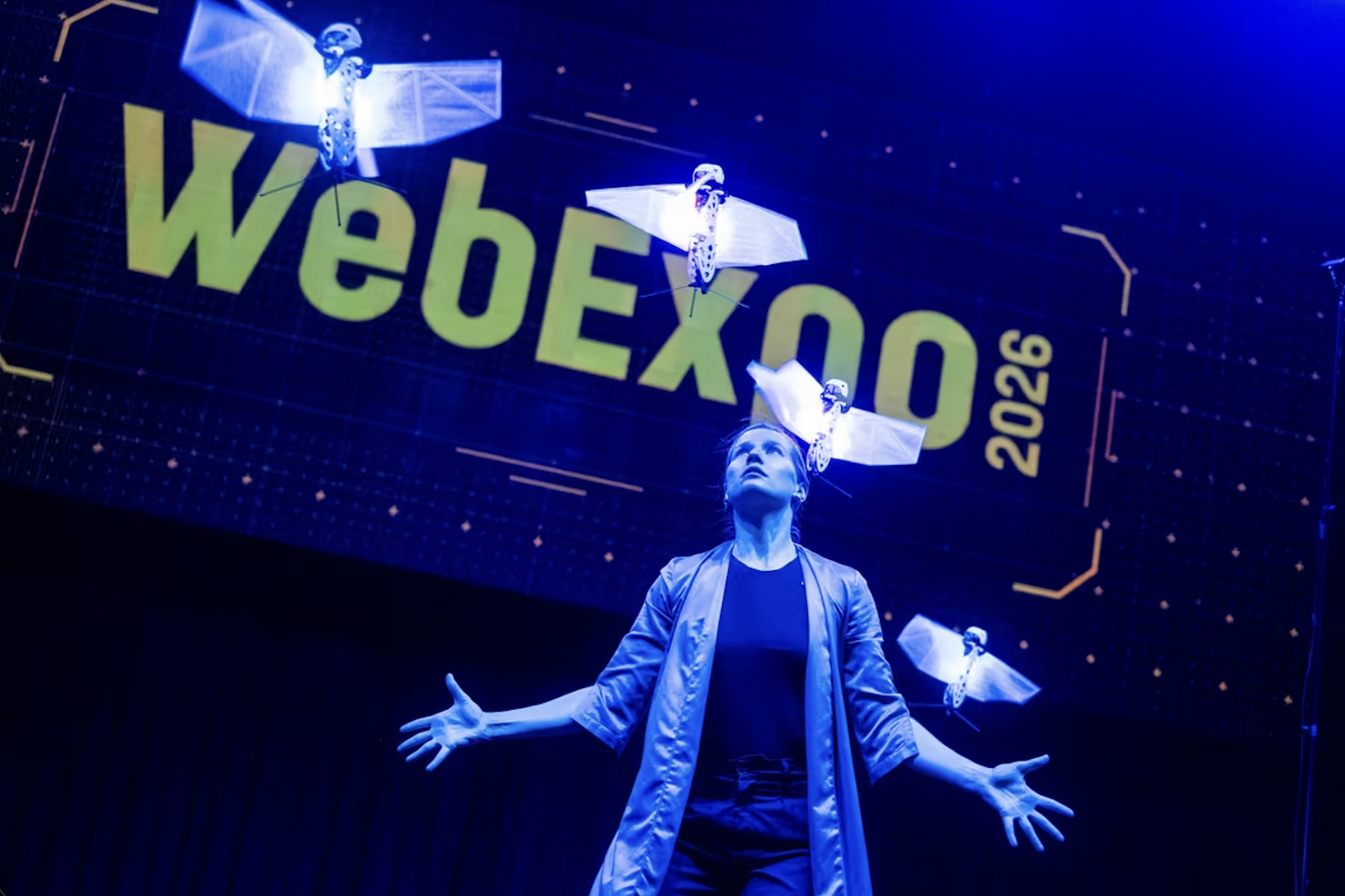
The conference opened with a dance and music performance involving drones. At first, I thought it was a slightly unusual way to open a technology conference. Then I realized it actually set up one of the main themes quite well. Humans and machines in symbiosis. Not machines instead of humans.
AI was discussed in a similar way throughout the talks. Less as a replacement, more as a tool. It can help with analysis, summarization, categorization, pattern recognition, or working with large amounts of data. In other words, exactly with the tasks that often take our time and energy, even though we would rather spend them thinking about the solution itself.
We should not forget, though, that AI often produces the average. It takes a lot of existing data and returns an output that looks reasonable, but is not necessarily new, correct, or good for a specific context.
And this is where I see an important difference. AI can take over a lot of repetitive work. The question is, what do we do with the space it creates for us? If we use it for better thinking, solution design, decision-making, and understanding context, AI can be a very strong helper. A strong helper, but still only a helper.
Bubble 2: Accessibility is a marginal topic
The biggest shift in my thinking probably came from the talks on accessibility.
At WebExpo, accessibility was not presented as something extra. No one started by defending why it matters. It was treated as a normal part of a quality product, and the discussion focused mainly on how to implement it faster and better.
In our environment, accessibility is often addressed only when the law or the client requires it. But a user does not start having a problem only once legislation gives that problem a name.
Recently, I looked at a colleague’s monitor. In one of our tables, we use zebra rows to help users stay oriented. On his screen, they were almost invisible. And this was a technical person who works with a computer every day. His display contrast simply was not set well.
How many doctors, accountants, warehouse workers, or eshop customers see our products differently than we think? And how many of them have their work made harder by a visual, motor, or other limitation?
Accessibility is not an extra layer. It is part of quality. Contrast, structure, forms, keyboard navigation, text, states, and errors. Basic things that determine whether a user can find their way through a product.
For me, the takeaway is simple: when designing a product, it is not enough to look at how good it looks on our own monitor. We need to verify whether it also works in real conditions, on different devices, and for people who do not use it in the same way we do. And sometimes all it takes is to look around the office.
Bubble 3: AI cannot write good copy
One of the talks included a simple but very good sentence: good copy is good copy. It does not matter whether it was typed letter by letter by a human or created with the help of AI. What matters is whether it works. Whether it guides the user, reassures them, explains the next step, and helps them complete the task they came into the system to do.
And this is exactly where the perspective of the creator and the user often differs. As developers, we think in features. We added a filter, sped up search, adjusted a table, simplified a form. The user does not see it that way. They do not want to work with our system; they want to get their task done and move on.
That is why copy is not filler. It is part of product navigation. A button, message, or action confirmation should explain what is happening, what will happen next, and what the person should do.
AI can help a lot with drafting text. But we still need to judge whether the text truly does its job. Because a nice sentence is not necessarily good copy.
Bubble 4: Everyone on the team wants the same thing
One of the stages hosted a format called Discomfort Zone – conversations about the less comfortable topics of work life, the things that do not fit neatly into idealistic LinkedIn stories, but that sooner or later every team has to deal with.
One of the conversations was titled A Lovecraftian descent into management, which already suggested that this would not be a typical leadership presentation. It was based on a Lovecraft story in which a scientist builds a device that allows a person to perceive the world beyond the usual range. Suddenly, he can see layers of reality that had always been around him, but that he had never been able to detect before.
Management can sometimes be similar.
Managers often see a different part of reality than the team: budgets, business risks, conflicts, client expectations, or information they cannot share yet. The team, on the other hand, sees technical limits, solution quality, user frustration, and day-to-day pressure.
Both sides may want a good outcome, but each is looking at a different part of the problem. And if we do not connect these perspectives, we will argue about solutions before we understand the other side’s reality.
Bubble 5: Facts are the strongest arguments
The last bubble burst during a talk on storytelling. It reminded me that facts gain more power when we place them into a specific situation, person, and consequence.
As technical people, we like data, metrics, charts, and tables. When something makes sense, we expect that to be enough. But people remember examples, situations, and consequences better than numbers alone.
That is why it is not enough to say that we improved something by 30%. It is important to show what that means in practice. A doctor has more time for a patient. A customer finds the right product faster. An internal team stops doing manual checks and can focus on more important work.
Facts matter. But we often understand value only when we see what they change in real life.
These five bubbles are only a selection of what surprised me at WebExpo. With several topics, I kept thinking: this is something we should do better, this is something I want to explore more deeply, this is something we can bring into our projects. I believe we will manage to do that.
And at the end, one more image stayed with me: on Wenceslas Square, Saint Wenceslas sits on a horse like a hero. In Lucerna, there is another Wenceslas – also sitting on a horse, except the horse is upside down and quite certainly dead.
It feels like a fairly accurate metaphor for technology.
In IT, it is possible to ride for a very long time on what once worked. On tools, processes, architectures, and certainties that got us to where we are today. But WebExpo reminded me that it is worth stopping from time to time, looking underneath us, and asking ourselves honestly: is this still carrying me forward, or is it time to change horses?

Frequently Asked Questions
What topics did WebExpo 2026 bring?
WebExpo 2026 brought topics such as AI in development, accessibility in digital products, UX copywriting, management, storytelling, and new ways of thinking about products. An important motif was also the collaboration between humans and technology.
Why does it make sense to attend technology conferences in person?
An in-person conference exposes people to topics they might not choose to watch at home. Thanks to that, they step outside their professional bubble and hear perspectives that would be harder to reach through social media algorithms.
How can AI help developers and product teams?
AI can help with analysis, summarization, categorization, pattern recognition, or repetitive work with large amounts of data. This gives the team more space for solution design, decision-making, quality control, and understanding broader context.
Why does AI need human guidance?
AI often assembles answers from a large amount of existing data, which means it can create outputs that seem reasonable but may not fit a specific context. Human review, technical direction, and responsible decision-making are therefore important.
Why is accessibility important in digital products?
Accessibility helps users find their way around and work with a digital product comfortably. It involves contrast, page structure, forms, keyboard control, text, states, and error messages.
What are the basic elements of accessibility on a website or in an application?
Basic accessibility elements include sufficient contrast, clear structure, properly labeled forms, keyboard control, readable text, clear system states, and understandable error messages.
What does good UX copy mean?
Good UX copy helps users understand what is happening, what comes next, and what step they should take. It is not just a nice sentence, but text that guides the user, reassures them, and helps them complete the task.
Can AI write good copy?
Yes, AI can help a lot with drafting text. What matters is judging whether the text works in a specific situation, whether it guides the user, and whether it fulfills its role. Good copy is good copy, regardless of whether it was written manually or with the help of AI.
Why do managers and teams often look at a project differently?
Managers often work with information about budgets, risks, client expectations, or long-term direction. The team, on the other hand, sees technical limits, solution quality, user problems, and the daily pressure of working on the product.
How does storytelling help explain product value?
Storytelling places facts into a specific situation, person, and consequence. Instead of presenting a number on its own, it shows what the change means in practice: more time for a doctor, a faster purchase for a customer, or less manual work for a team.
Why are data and metrics alone not enough in products?
Data and metrics are important, but people remember concrete examples, situations, and impact on real work more easily. Product value becomes clearer when it is obvious what it changes for the user in everyday life.
What does the metaphor of the dead horse mean in technology?
The dead horse metaphor refers to tools, processes, or certainties that once worked but may no longer move a project forward. In IT, it is therefore worth regularly checking whether the way we work still creates value.